


Real-Time Editorial Analytics
Learn how to perform real-time editorial analytics with Snowplow and ClickHouse
Welcome to the Real-time Editorial Analytics solution accelerator for media publishers.
This accelerator demonstrates how to leverage real-time Snowplow event data with ClickHouse Cloud to understand article engagement and user behavior on a media publisher site.
Through this hands-on guide, you'll learn how to build, deploy, and extend real-time, event-driven architectures using Snowplow and ClickHouse. The framework is inspired by real customer use cases in media.
This accelerator is open source (Apache 2.0). Feel free to use it as the foundation for practical applications such as real-time viewer insights, engagement analytics, ad performance tracking, or personalized content recommendations.
Architecture
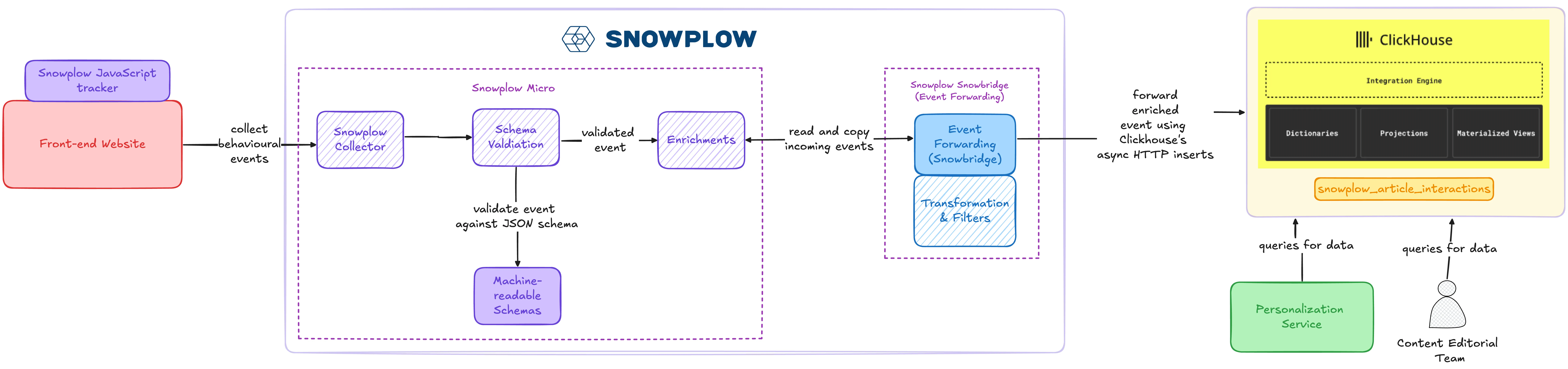
The solution comprises several interconnected components:
- Web tracking application:
- A Next.js application with a number of articles and advertisements
- Snowplow tracking for events related to article engagement, e.g., article impressions, article views, ad impressions, ad clicks, or page pings, sent to the Snowplow Collector
- Code available in the
snowtype.tsfile in GitHub
- Snowplow Micro:
- Snowplow Micro is a lightweight version of the Snowplow pipeline which can be run locally
- It passes validated and enriched events to Snowbridge
- Snowplow Snowbridge (also known as Event Forwarding):
- Filters incoming Snowplow events to only forward a subset of events and dimensions to ClickHouse
- Publishes events and lands events in a single table in ClickHouse using ClickHouse's HTTP interface
- ClickHouse Cloud:
- ClickHouse Cloud receives and stores events from Snowplow
- Stored data can be queried using ClickHouse's UI or via API
The following diagram maps out where each component sits in the end-to-end communication flow.
Prerequisites
You'll need a ClickHouse Cloud account to receive the Snowplow events. A 30-day free trial signup is available.
Acknowledgments
Thank you to the ClickHouse team for their support and collaboration with building this accelerator.
Build it on your own data.
See it running on your use case, with your team.